
Lawyerlinked — Find and Connect with Lawyers Online
Delhi High Court Rules Attendance Cannot Bar Law Students from Exams: A Landmark Verdict
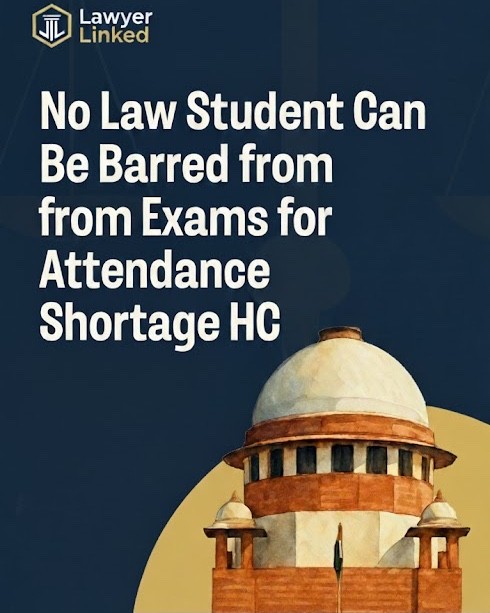
ATTENDANCE SHOULD NOT BE A REASON TO BAR LAW STUDENTS FROM ATTENDING EXAMS
Delhi High Court delivered a landmark judgement which questioned the very philosophy that has governed our educational institutions for decades. On November 3, 2025 Delhi HC held: no law student in India can be detained from examinations or prevented from academic progression solely on the grounds of attendance shortage. In the judgement Justice Prathiba M. Singh and Justice Amit Sharma wrote that
"In order to obtain such holistic education, mere presence in classrooms is neither required nor can be sufficient."
The incident that sparked the judgement was the suicide of Sushant Rohilla, a third-year law student at Amity Law School, Delhi which was then affiliated to Guru Govind Singh Indraprastha University in 2016. According to a letter sent by his friend to Chief Justice of India, he was harassed by the college authorities and one particular teacher. He was barred to attend 6th semester exam due to attendance shortage. College tried to force him into repeat a year. He committed suicide due to this unbearable pressure. His death became a symbol of a systemic problem that has been plaguing our education system.
The judgement made by Delhi HC is reformative of the entire legal education system. The court emphasized that
"Having considered the stark realities that have come to the surface, this court is strongly of the view that norms in education in general and legal education in particular cannot be made so stringent so as to lead to mental trauma, let alone death of a student."
The court highlighted that educational system should change according to time. Court emphasized the importance of multidisciplinary study in fields like law. Law is such a field where practical knowledge is much more important than classroom lectures. For that participating in extracurricular activities such as webinars, conferences, moots and ADR are very important. The court held that it is dealing with a professional course i.e. legal education, which is designed not only to teach students theories of law but also to train them for the practice of law. Court noted that legal education has various dimensions.
• First dimension - Knowledge of law – studying various statutes, rules and regulation. Learning of jurisprudence and interpretation of law part of this first dimension.
• Second dimension - Practical application – students have to participate in peer discussions, debates, seminars, conferences, moot court and other activities which provide knowledge of practical applicability of law.
• Third dimension - Implementation of law – for these students have to visit courts, prisons and other such places to know how the law is implemented.
Through this court is pointing towards a more practical based education approach in legal studies. Court also resonated with the mental and financial distress caused by the attendance issue.
DIRECTIONS BY COURT TO BCI
1. No law student should be detained from attending exam or prevented from academic progression due to attendance shortage.
2. No college should mandate more attendance norms than that prescribed by BCI as minimum attendance percentage.
3. Students should be provided weekly attendance notification and in case of shortage then at the end of every month guardians should be notified. Also, extra classes should be conducted for those students with attendance shortage in either online or offline mode.
4. Instead of detention, grade reduction should be the punishment for attendance shortage.
5. BCI should reconsider the mandatory attendance requirements (rule 10 and 12 of Legal Education Rules, 2008) for LLB to make it in line with NEP 2020 and UGC requirements.
6. Adequate flexibility in academics should be bought so that students can participate in moot courts, seminars, practical learning etc
7. BCI should incorporate ways to credit law students for practical activities such as moot court participation.
8. BCI should consult with students, teachers and parents to take measures that safeguard the mental health of students.
9. All colleges should create Grievance Redressal Committees which should consist of
• UGC regulations to be amended to make student nominees consisting of 50% of total members. They should be full time members rather than mere invitees. Till amendment is done at least 2-3 students should be appointed as members.
• Counsellors and therapist should be members.
10. BCI should ensure internship accessibility to all law students especially from economically weaker backgrounds, remote areas, and differently-abled students.
The BCI and other regulatory bodies now have a clear mandate to rethink outdated norms. This judgement would be a start to revolutionize not only the legal educational system but the entire higher educational system in India.