
Lawyerlinked — Find and Connect with Lawyers Online
Do Governors Have Too Much Power? The 2025 SC Clarification
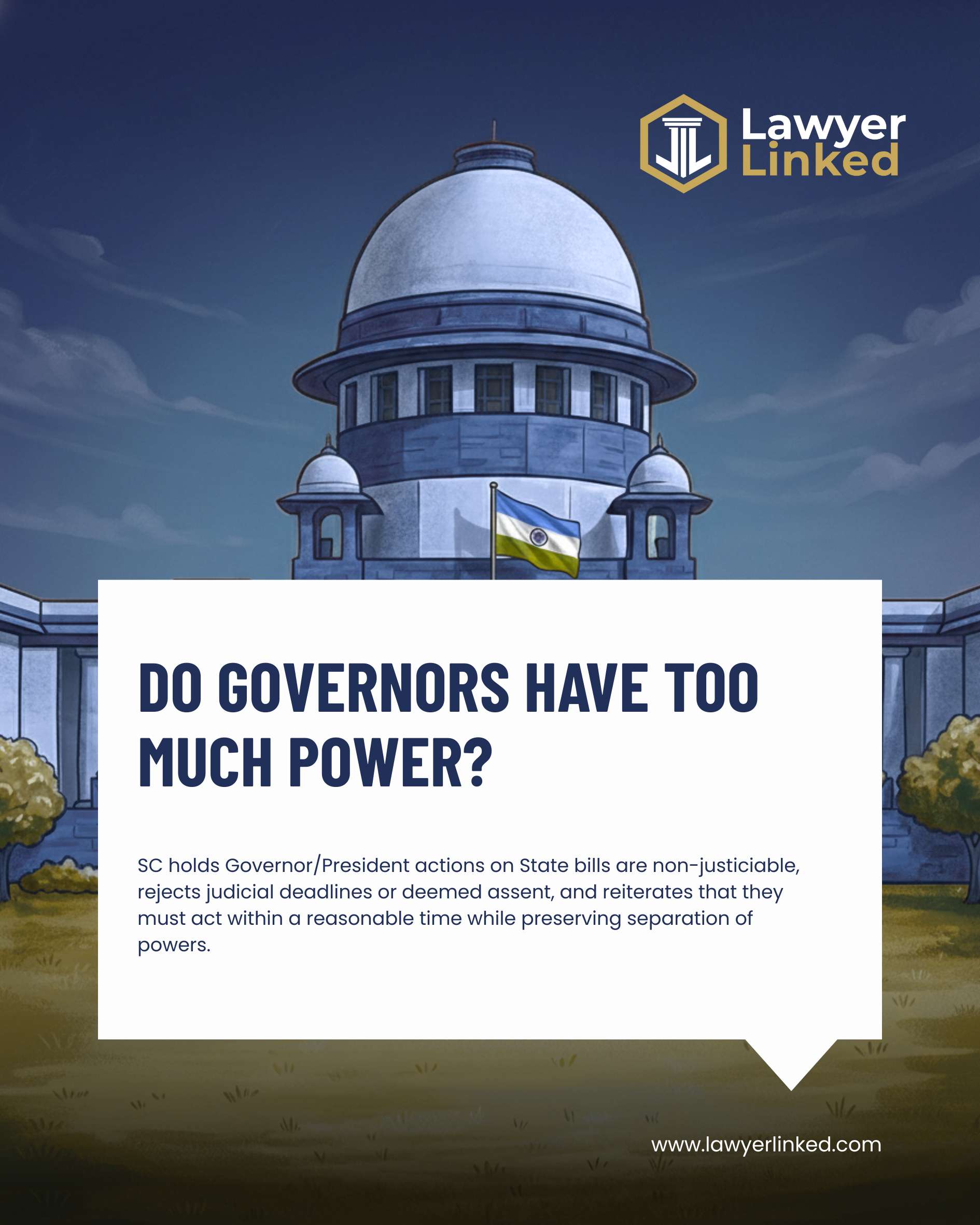
Re: Assent, Withholding, or Reservation of Bills by the Governor and President of India (2025 INSC 1333)
In a significant constitutional development, the Supreme Court of India delivered clarity on the scope of powers exercised by Governors and the President regarding assent to State bills. The reference, made by the Union Government under Article 143, sought the Court’s opinion on whether judicial deadlines could be imposed on these high constitutional authorities when granting or withholding assent.
The matter gained urgency after earlier judicial observations suggested the possibility of fixing timelines and even introducing deemed assent in cases where Governors delayed action on bills. This created concerns about the delicate balance between the judiciary and the executive within India’s federal structure.
A five-judge Constitution Bench held that while the Governor must act within a “reasonable time,” the Constitution does not permit courts to enforce strict deadlines. The Court affirmed that the Governor has only three constitutionally recognized options when a bill is presented:
1.Grant assent,
2.Withhold assent, or
3.Reserve the bill for consideration of the President.
Importantly, the Bench ruled that the actions of both the Governor and the President are non-justiciable, meaning courts cannot question or compel the manner or timing of their decisions. It further declared that deemed assent is unconstitutional, as it would amount to judicial rewriting of the Constitution.
The judgment reinforces the doctrine of separation of powers, preventing judicial overreach into executive discretion while ensuring that these constitutional authorities do not indefinitely stall the legislative process. It also has wide implications for State legislation, Centre–State relations, and the functioning of India’s federal political structure.
Ultimately, the ruling preserves the constitutional autonomy of the Governor and the President, while reminding them of the responsibility to act within a reasonable timeframe to maintain the democratic flow of governance.